Results from InfraVec2 project shed a light on habitat characteristics of multiple mosquito vectors in Europe and Africa.
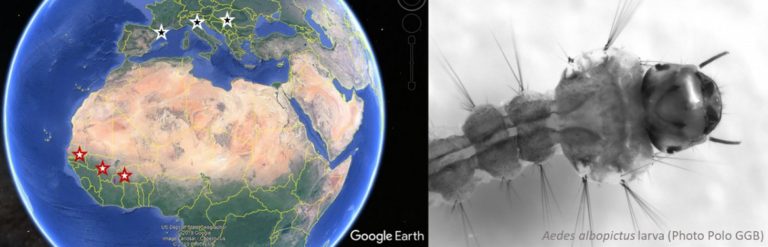
What is the research about? Polo GGB is partner of a European African collaboration within the EU funded InfraVec2 project, looking at mosquito abundance and environmental parameters within natural habitats for five important mosquito vectors across 6 countries in Europe and Africa.
Why is it important? Mosquito-borne diseases are increasingly a burden for human health. The surveillance of mosquito habitat help us understanding mosquito ecology and develop tools to predict mosquito activity, conduct accurate laboratory studies and, subsequently, assess disease risks.
What did we found? We determined the abundance of mosquito aquatic stages (larvae and pupae) and characteristics of breeding sites (type and water volume, water temperature, conductivity and turbidity).
Results are described in the manuscript “A litmus test for harmonized mosquito monitoring across Europe and Africa”, available on bioRxiv, the preprint server for biology. Full description of the study can be found on the InfraVec2.
Research partners: Centre de Recerca en Sanitat Animal (Spain); Centro Agricoltura Ambiente “G. Nicoli” (Italy); Malaria Research and Training Centre Université de Bamako (Mali); Imperial College London (UK); Institut Pasteur de Dakar (Senegal); Centre National de Recherche et de Formation sur le Paludisme (Burkina Faso); University of Novi Sad (Serbia).
Ignazio Graziosi, Polo GGB