


Greta Immobile Molaro g.immobile@pologgb.com
Introgression of a synthetic sex ratio distortion transgene into different genetic backgrounds of Anopheles coluzzii (link) Paola Pollegioni, Tania Persampieri, Roxana L. Minuz, Alessandro Bucci, Alessandro Trusso, Salvatore Di Martino, Chiara Leo, Marco Bruttini, Marco Ciolfi, Ann‐Marie Waldvogel, Frédéric Tripet, Alekos Simoni, Andrea Crisanti, Ruth Müller, Insect Molecular Biology, 10.1111/imb.12813, 32, 1, (56-68), (2022).
Gene-drive suppression of mosquito populations in large cages as a bridge between lab and field (link) Andrew Hammond, Paola Pollegioni, Tania Persampieri, Ace North, Roxana Minuz, Alessandro Trusso, Alessandro Bucci, Kyros Kyrou, Ioanna Morianou, Alekos Simoni, Tony Nolan, Ruth Müller & Andrea Crisanti, Nat. Commun. 12, 4589 (2021).
Detecting the population dynamics of an autosomal sex ratio distorter transgene in malaria vector mosquitoes (link) Paola Pollegioni, Ace R. North, Tania Persampieri, Alessandro Bucci, Roxana L. Minuz, David Alexander Groneberg, Tony Nolan, Philippos-Aris Papathanos, Andrea Crisanti, Ruth Müller. . J. Appl. Ecol. 57, 2086–2096 (2020).
A CRISPR–Cas9 Gene Drive Targeting Doublesex Causes Complete Population Suppression in Caged Anopheles Gambiae Mosquitoes (link) Kyrou, Kyros, Andrew M Hammond, Roberto Galizi, Nace Kranjc, Austin Burt, Andrea K Beaghton, Tony Nolan, and Andrea Crisanti. Nature Biotechnology 36, no. 11 (November 2018): 1062–66.
Recommendations for Laboratory Containment and Management of Gene Drive Systems in Arthropods (link) M. Benedict et al. - Vector-Borne and Zoonotic Diseases, Jan 2018.
Cross-Species Y Chromosome Function Between Malaria Vectors of the Anopheles gambiae Species Complex (link) F. Bernardini et al. - Vol 207 Issue 2, Oct 2017
The creation and selection of mutations resistant to a gene drive over multiple generations in the malaria mosquito (link) Andrew M. Hammond, et al. PLoS Genet. e1007039, 2017.
Radical remodeling of the Y chromosome in a recent radiation of malaria mosquitoes (link) A.B. Hall et al. PNAS 113, E2114–E2123, 2016.
A CRISPR-based Gene Drive System Targeting Female Reproduction in the Malaria Mosquito (link) A. Hammond et al. - Nature Biotechnology 34,78–83, 2016.
A CRISPR-Cas9 sex-ratio distortion system for genetic control (link) R. Galizi et al. - Nature S. R. 6, Art n°. 31139, 2016.
Every year, malaria affects over 249 million people and causes more than 597,000 deaths worldwide.
Around one-third of the global population is at risk of contracting this mosquito-borne disease. The most alarming statistic concerns children under the age of five, who account for 70% of all malaria-related deaths: on average, one child dies every minute.
Antimalarial drugs, insecticide-treated bed nets, and indoor insecticide spraying have helped to reduce the spread of malaria, but they have not succeeded in eliminating the disease in countries where it remains endemic. According to the World Health Organization’s 2023 World Malaria Report, progress in the fight against malaria has slowed dramatically since 2015 and has stagnated for the past three years. The WHO warns that we are at a critical turning point. Without new solutions, achieving the targets of the global malaria strategy will be extremely difficult.
In response to this global health challenge, Target Malaria was established as a university-led research initiative with the mission to reduce the population of malaria-transmitting mosquitoes in sub-Saharan Africa through the use of cutting-edge genetic technologies. The goal is to limit malaria transmission by targeting the mosquito vector directly, through sustainable, effective, and accessible solutions.
Target Malaria is a research consortium bringing together scientists, stakeholder engagement teams, regulatory affairs experts, project management teams, risk assessment specialists and communications professionals. The consortium operates through research centers across Africa, Europe, and North America, and works in close collaboration with several African countries.
Polo GGB is a strategic partner of Target Malaria. It contributes to the development of gene drive technology and hosts a state-of-the-art research infrastructure, including an insectary capable of simulating different environmental conditions, including the tropical climate of Africa. Here, genetically modified mosquito strains are studied under contained use.
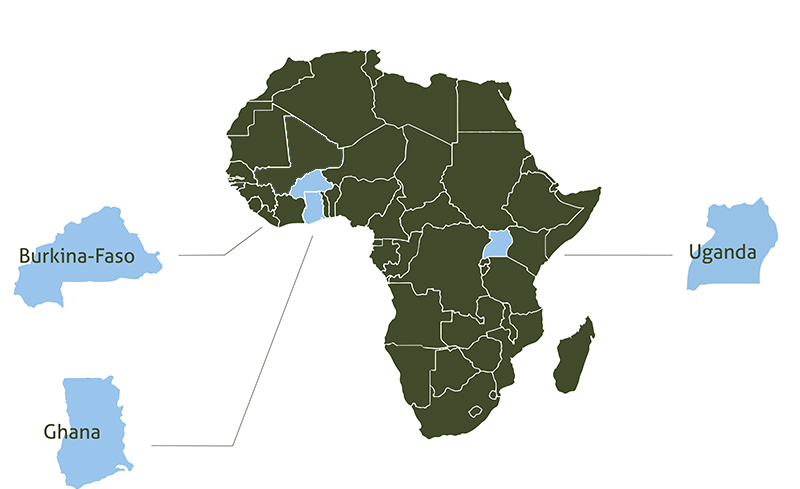
Polo GGB works closely with Professor Andrea Crisanti, a pioneer in mosquito genetic modification research, and with his laboratory at Imperial College London. Other key partners in the consortium include the CDC Foundation in the United States, Imperial College London, the University of Oxford in the United Kingdom, the Institut de Recherche en Sciences de la Santé in Burkina Faso, the Uganda Virus Research Institute, and the University of Ghana.
The project focuses on the development of gene drive, an innovative technology that enables the rapid spread of specific genetic traits within an insect population. In this case, the goal is to reduce the fertility of female mosquitoes, thereby limiting their reproductive capacity and, in turn, the transmission of malaria.
Genetically modified mosquito strains undergo rigorous safety and efficacy testing in controlled environmental conditions. These tests also include trials in large cages designed to simulate semi-natural environments.
This is where Polo GGB plays a vital role. By studying mosquito populations in contained, controlled settings, researchers can assess the long-term effectiveness of the technology in reducing the vector population. During these trials, data will be collected on the characteristics of the modified mosquitoes, the performance of the technology, and crucial safety and risk-related aspects.
This information will be essential for making informed, responsible decisions about the potential use of gene drive technology in the fight against malaria.